For anyone who is interested, I did a more than one-hour long interview on the book with University of Florida alum Camelia Raghinaru for her extraordinary and timely podcast, ‘Theory to No End.‘
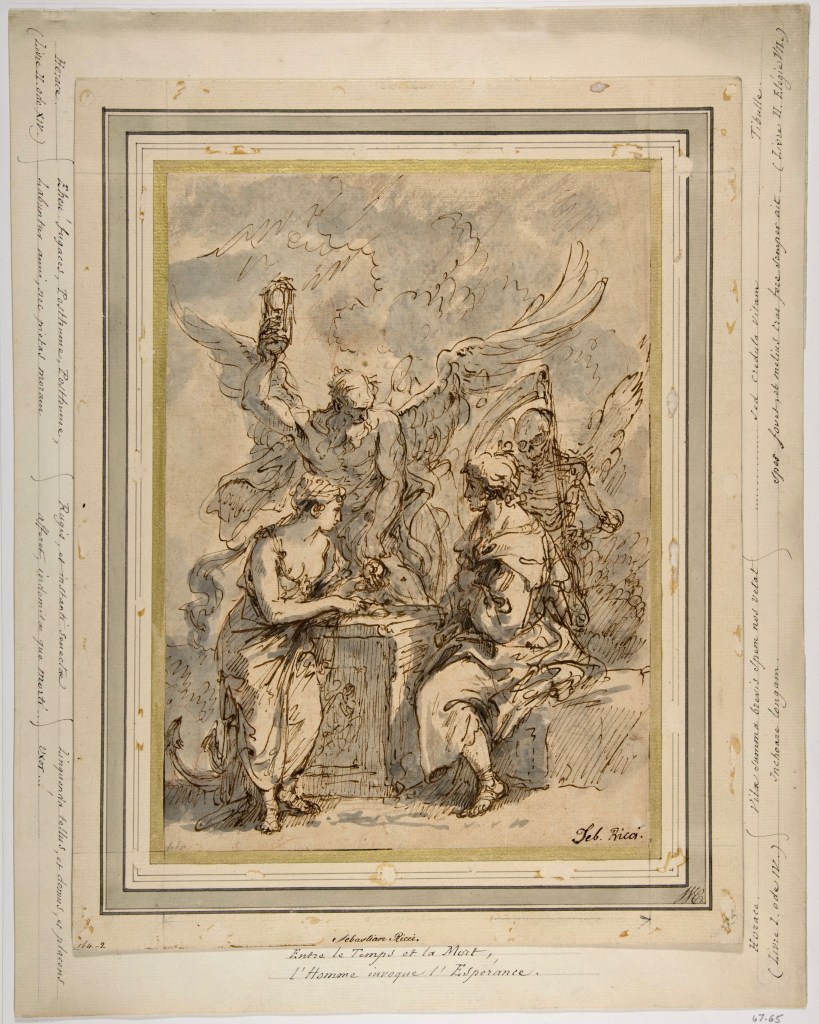
The book’s main title comes from an etching by Sebastiano Ricci, Allegory with Figures of Hope, Time, and Death (1659-1734) that the press generously reproduced as a frontispiece and which I post here in color.
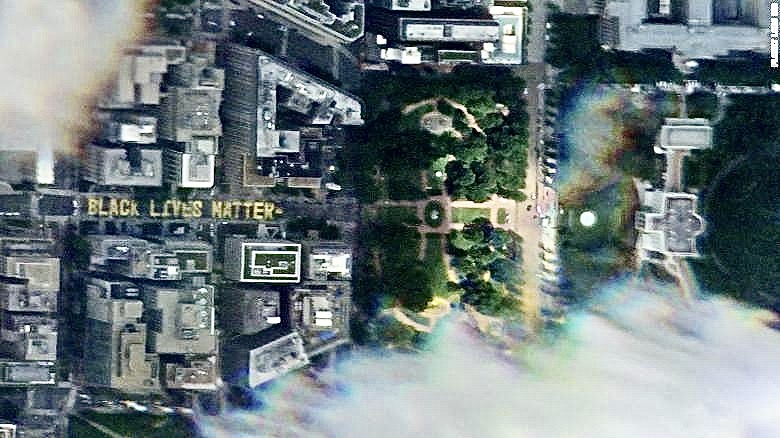
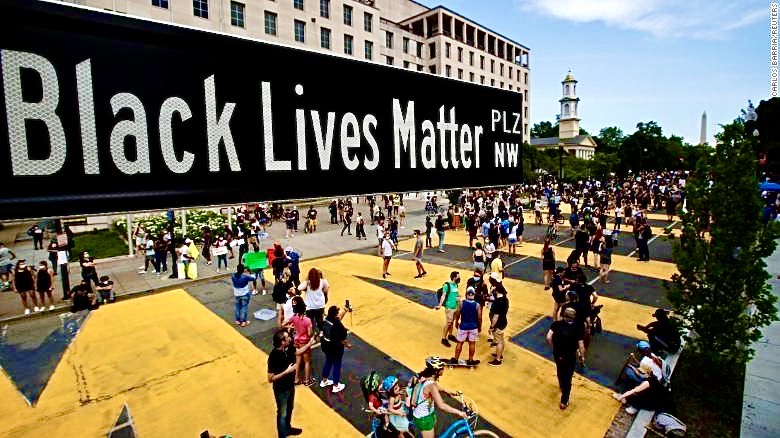
The protests following the May 25, 2020 murder of George Floyd in Minneapolis has brought back into prominence the phrase, “Black Lives Matter.” This has resulted in such admittedly symbolic but still necessary gestures as the Mayor of Washington renaming a portion of 16th Street leading up to the White House Black Lives Matter Plaza.
The phrase Black Lives Matter was first used in summer 2013 by the activists Alicia Garza, Patrisse Cullors, and Opal Tometi in response to the acquittal of George Zimmerman for the murder on February 26, 2012 of 17-year old Trayvon Martin. The following summer it came to even greater national and international prominence in the protests that erupted after the fatal shooting by a police officer in Ferguson, Missouri of 18-year old Michael Brown, Jr.
Not unsurprisingly, shortly on the heels of the initial success of Black Lives Matter in mobilizing a diverse coalition there emerged the competing slogan “all lives matter,” which was quickly and cynically seized upon by a range of neo-conservatives, including Ben Carson and Donald Trump, who claimed that the Black Lives Matter privileged one group of lives over others.
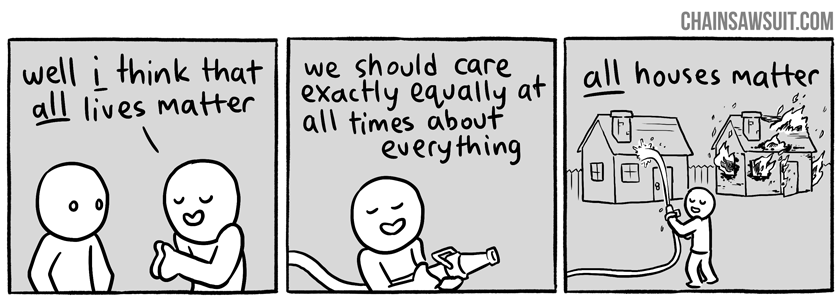
In recent weeks, I have seen a number of well-meaning people seize upon a counter-defense nicely summarized in this cartoon from a few years ago I found online:
The problem with this gesture is that while it is true that a house that is burning has priority over those that are not, how do we prioritize one house when multiple houses are all aflame at once? In my last blog post, I cited Greta Thunberg deploying, rightly, the same phrase in reference to climate change: “I want you to act as if our house in on fire. Because it is.” Moreover, is there a more burning issue for First Nations peoples than the accelerated dispossession of their lands and the destruction of their communities by the policies of the Trump administration? Or for those from the global south seeking asylum and economic opportunity for themselves and their loved ones than radical changes in immigration policies? Or for children working in sweatshops or undocumented farm workers or even adjunct faculty members than a fundamental restructuring of the global economy? As the Floyd case and so many others that have been (thankfully) recently caught on video bear out, just because we don’t, or can’t, see a particular fire doesn’t mean it is not ravaging many lives.
Then why the privileging of Black Lives Matter as the rallying cry today? What both responses, the conservative (all lives matter) and liberal (these lives matter more now), miss is the universal dimensions of the clarion call that is Black Lives Matter. The is because, as Slavoj Žižek among others has pointed out, the phrase Black Lives Matter, far more than the abstract “all lives matter,” expresses a drive toward what Žižek terms concrete universality.
How does this work? We need to begin by making explicit the unstated qualifying presupposition of each phrase as it is deployed today by opposed communities:
All lives matter . . . except those lives— black lives, poor and working-class lives, immigrant lives, differently abled lives, queer lives, etc.—that are the outside the charmed circle of lives that matter.
Black Lives Matter . . . as much as the more privileged lives inside that circle.
The former exemplifies what Žižek terms the universal exception: “The ‘universal exception’, according to Lacan, is the fundamental feature of the symbolic order (the ‘big Other’) as the order of universality: each universality is grounded in its constitutive exception.”
In its original formulation, the preamble to the constitution functioned in the same way: “We hold these truths to be self-evident, that all men are created equal, that they are endowed by their Creator with certain unalienable Rights, that among these are Life, Liberty and the pursuit of Happiness.” As anyone who knows anything about American history recognizes, these words were penned by white property-owning men whose intent (and this is also the problem of so-called constitutional originalists) was that women, people of color, and even white men without property be excluded from the group named “all men.” It was only later coordinated political action on the part of these excluded people—taking up as their mantras, all property-less men are created equal to propertied men, all men of color are created equal to white men, all women are created equal to men, all differently abled people are created equal to normatively abled people, all queer people are created equal to heteronormative people (all of them in common having nothing to lose but their chains)—that the notion was gradually expanded into the more universal understanding we hold today. Moreover, this is a struggle that very much continues into the present, as this week’s Supreme Court rulings extending civil rights protections to LGBTQ+ people and protecting (at least for now) DACA recipients bear out.
A similar logic is at work in what many conservatives ingeniously refer to as the apparently universal position of “pro-life.” The phrase pro-life far too often serves as mask for what is simply anti-abortion, which is grounded on the deeply patriarchal false universal that all lives matter . . . until the moment they leave the womb. Then some lives—those whose parents cannot afford health care or adequate nutrition, who happen to be born to parents outside the United States, who are of a different faith, who are part of a population deemed by political leaders to be our enemies, and so forth—become of very little concern to many self-proclaimed pro-lifers. The counter that every pre-natal life is a universal exception and hence less valued in our society has a kinship with the notion of “blues lives matter:” both arise from the presupposition that these lives matter less in the eyes of our permissive liberal institutions than the lives of women, or black, poor, immigrant, or queer people. Both claims are simply ideology and readily can be demonstrated as false. For example, a crucial proof that black lives are undervalued is the treatment of black people who otherwise reside within the charmed circle. In recent years, men in positions of power and prestige—members of congress, medical doctors, Harvard professors—have all been documented victims of police harassment simply because they happened to be black men at the wrong place and at the wrong time.
Conversely, in the Christian New Testament, the second of two commandments issued by Jesus (“There is no commandment greater than these”) is not “love all men as yourself” (i.e. all men matter) but rather “Love your neighbor as yourself” (NIV: Mark 12: 31). This is because it is only by way of the universal exception—the neighbor, the one excluded by Margaret Thatcher’s infamous 1987 assertion “there’s no such thing as society. There are individual men and women and there are families”—can the concrete universality of the first commandment be realized: “Love the Lord your God with all your heart and with all your soul and with all your mind and with all your strength” (NIV: Mark 12: 30).
The only path to get to a concrete universal—a true All Lives Matter, all are created equal, pro-life position—is by first embracing an actual universal exception as the basis of political engagement. Such a starting point by no means guarantees the destination— as Nancy Fraser and others point out, liberal feminism too often pulls up short of becoming a concrete universal; and Jodi Dean in her timely recent book, Comrade: An Essay on Political Belonging (2019) argues that the notion of allyship, which has also in the current moment risen to new prominence, at times “reflects the shrinking or decline of the political. . . the term ally appears more to designate a limit, suggesting you will never be one of us, than it does to enable solidarity.”
Nevertheless, only a concrete universal exception can inaugurate the chain that will continuously expand to include all others. In this way, Black Lives Matter comes to include immigrant lives, differently abled lives, queer lives, poor and underemployed lives, and every other under-valued life. This is what Angela Davis so powerfully expresses when she notes in response to Hillary Clinton’s use at a talk in Florissant, Missouri of the phrase all live matter only days after the June 17, 2015 murder of nine black lives (Clementa C. Pinckney, Cynthia Marie Graham Hurd, Susie Jackson, Ethel Lee Lance, Depayne Middleton-Doctor, Tywanza Sanders, Daniel L. Simmons, Sharonda Coleman-Singleton, and Myra Thompson) at the Emanuel African Methodist Episcopal Church in Charleston, South Carolina: “If indeed all lives mattered, we would not need to emphatically proclaim that ‘Black Lives Matter.’ Or, as we discover on the BLM website: Black Women Matter, Black Girls Matter, Black Gay Lives Matter, Black Bi Lives Matter, Black Boys Matter, Black Queer Lives Matter, Black Men Matter, Black Lesbians Matter, Black Trans Lives Matter, Black Immigrants Matter, Black Incarcerated Lives Matter, Black Differently Abled Lives Matter. Yes, Black Lives Matter, Latino/Asian American/Native American/Muslim/Poor and Working-Class White Peoples Lives matter. There are many more specific instances we would have to name before we can ethically and comfortable claim that All Lives Matter.” For similar reasons, Žižek finds the “+”in the slogan LGBTQ+ the sign of its potential insurgent universality; and a pro-life position that was a true concrete universal would not only be against abortion it would be actively for universal health care, guaranteed universal income and housing, equal schooling, and open borders; and against police violence, war, economic exploitation, and so much more.
All of this bears out the fact that in our present context not only the universal goal—Black Lives Matter as much as all others—but the more particular one of systemic police reform, will not occur without a fundamental remaking of society. Our call should not be simply to defund the police, but to defund an inequitable, unjust, oppressive, and exploitative reality itself. To those who say such a concrete universality and the admittedly arduous labor of building solidarity across different communities and interests is unrealistic, impossible, and utopian, I would suggest we respond with one of the great slogans of 1968, a year a number of commentators have pointed out resonates with our own (and if this is the case, may the second half of 2020 come to very different conclusions): Soyez réalistes, demandez L’impossible (Be realistic, demand the impossible).
Today, Time magazine released a prose poem by Titus Kaphar entitled “I Cannot Sell You This Painting,” intended to accompany his painting that appears on the cover of the June 15 issue of the magazine. It is deeply moving and powerful short work, and I would encourage everyone to read and meditate on it. (I have posted links at the end of this essay to the poem and a few other pieces I touch on.) Well into the poem, Kaphar cries out, “Do/ not/ ask/ me/ to/ be/ hopeful;” and then again a little further on, he observes, “And so those without hope…/ Burn./ This Black mother understands the fire./ Black mothers/ understand despair./ I can change NOTHING in this world,/ but in paint,/ I can realize her…./ This brings me solace…/ not hope,/ but solace.”
In January 2019, the extraordinary young climate change activist Greta Thunberg concluded her stirring address to Davos World Economic forum in a similar fashion:
Adults keep saying: “We owe it to the young people to give them hope.” But I don’t want your hope. I don’t want you to be hopeful. I want you to panic. I want you to feel the fear I feel every day. And then I want you to act.
I want you to act as you would in a crisis. I want you to act as if our house in on fire. Because it is.
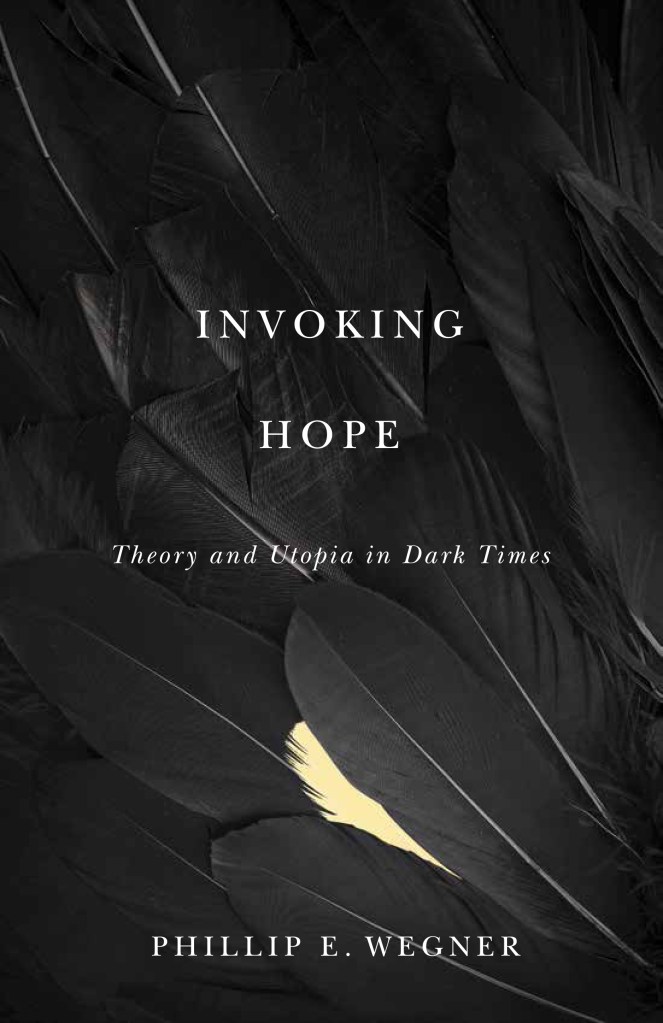
As someone who has just completed a book with the title, Invoking Hope: Theory and Utopia in Dark Times, both Kaphar and Thunberg raise questions that have been on my mind for a good while now. There is a long tradition of deeply committed artists and intellectuals decrying the false comforts of shallow hope or easy optimism. Such a critique is at the heart of Joseph Conrad’s summary statement on European civilization issued at the dawn of the twentieth century and in response to atrocities he witnessed first-hand: “The horror! The horror!” It is also at the center of Theodor Adorno’s formulation of negative dialectics; and in his book of that title, Adorno notes, “People to whom despair is not a technical term may ask whether it would be better for nothing at all to be than something.”
In the preface to his first collection, Na Han (Call to Arms)(1922), Lu Xun—in a passage I often refer to in my teaching—recalls a parable he had presented a few years earlier to a close friend:
Imagine an iron house without windows, absolutely indestructible, with many people fast asleep inside who will soon die of suffocation. But you know since they will die in their sleep, they will not feel the pain of death. Now if you cry aloud to wake a few of the lighter sleepers, making those unfortunate few suffer the agony of irrevocable death, do you think you are doing them a good turn?
Lu Xun tells us that his friend replied, “But if a few awake, you can’t say there is no hope of destroying the iron house.” Lu Xun then concludes his anecdote by noting, “True, in spite of my own conviction, I could not blot out hope, for hope lies in the future. I could not use my own evidence to refute his assertion that it might exist. So I agreed to write, and the result was my first story, ‘A Madman’s Diary.’ From that time onwards, I could not stop writing, and would write some sort of short story from time to time at the request of friends, until I had more than a dozen of them.”
I am convinced that Lu Xun’s words offer an effective means to understand the import of what Kaphar, Thunberg, Adorno, and Conrad touch on each in their own unique way. I would suggest that all of these great figures are in fact not referring to authentic hope, but rather to its shallow cousin, optimism—what Antonio Gramsci refers to as an “optimism of the intellect,” and especially, as Thunberg also so effectively underscores, when such an optimism is accompanied by a “pessimism of the will.” And in this I fully concur with Gramsci in relationship to his terrible moment and Kaphar and Thunberg to our own: there is nothing more dangerous than the false promise of this shallow form of hope.
However, the true negation of hope is despair, and despair—a pessimism of the intellect and will—is expressed in passivity and silence; and it is precisely such passivity and silence that both Kaphar and Thunberg refuse in the very act of writing. A figure of such a despair is to be found in Conrad’s work in the novel that is perhaps his masterpiece, Lord Jim (1900): in Captain Brierly, who after coming to a fundamental realization about himself (“A man may go pretty near through his whole sea-life without any call to show a stiff upper lip. But when the call comes . . . Aha! . . . If I . . .”), we learn “committed suicide very soon after.” The opposite of Brierly, and a figure for Conrad of authentic hope, is to be found in the narrator of both “Heart of Darkness” and Lord Jim, Charles Marlow, who tells the truth of what he has experienced to his sole remaining audience member on board the Nellie and to the “privileged man” who receives his final letter. For Marlow, as for Conrad, it is lies—and that most insidious form of the lie which is silence—that are “too dark – too dark altogether . . .” Similarly, in the case of Lu Xun, Adorno, Thunberg, and Kaphar, the depth of their hope becomes manifest in the fact that even though each of them “knows” things are hopeless (pessimism of the intellect) they nevertheless continue to act (optimism of the will), painting their pictures, telling their stories, teaching their students, and working to change the world. (Need I add that such a stance is very different from either romanticism—an enthusiastic but quickly spent optimism of the intellect and will—and cynicism—the combination of a pessimism of the intellect with an optimism of the will, the willingness to act as if everything is fine even though we know the house is on fire or the air is running out in the iron house). They all offer their message, as Adorno and his co-author Max Horkheimer write near the climax of Dialectic of Enlightenment, “not to the ‘masses’ and not to the individual (who is powerless), but to an imaginary witness—lest it perish with us.”
We need this form of hope now more than ever in these increasingly dark times and I truly thank people like Thunberg and Kaphar who give such a gift to us. It is such a hope that Pope Francis also had in mind when he recently observed, “Optimism disappoints, but hope does not.”
* * *
Here are the links to some of the essays I discuss. I take up Gramsci’s message, and present the Adorno and Pope Francis quotes, in the Conclusion to Invoking Hope. The Conrad citations are from Heart of Darkness and Lord Jim.

 Phillip E. Wegner